Working for a US Client from the Netherlands: Invoicing, VAT and Getting Paid (2026)
A US client often pays well, then sends a W-8BEN, asks for a tax ID and lets your invoice sit for six weeks. The whole picture in the order you will hit it: VAT, the form, getting paid in dollars, and the invoice details that get paid on time.
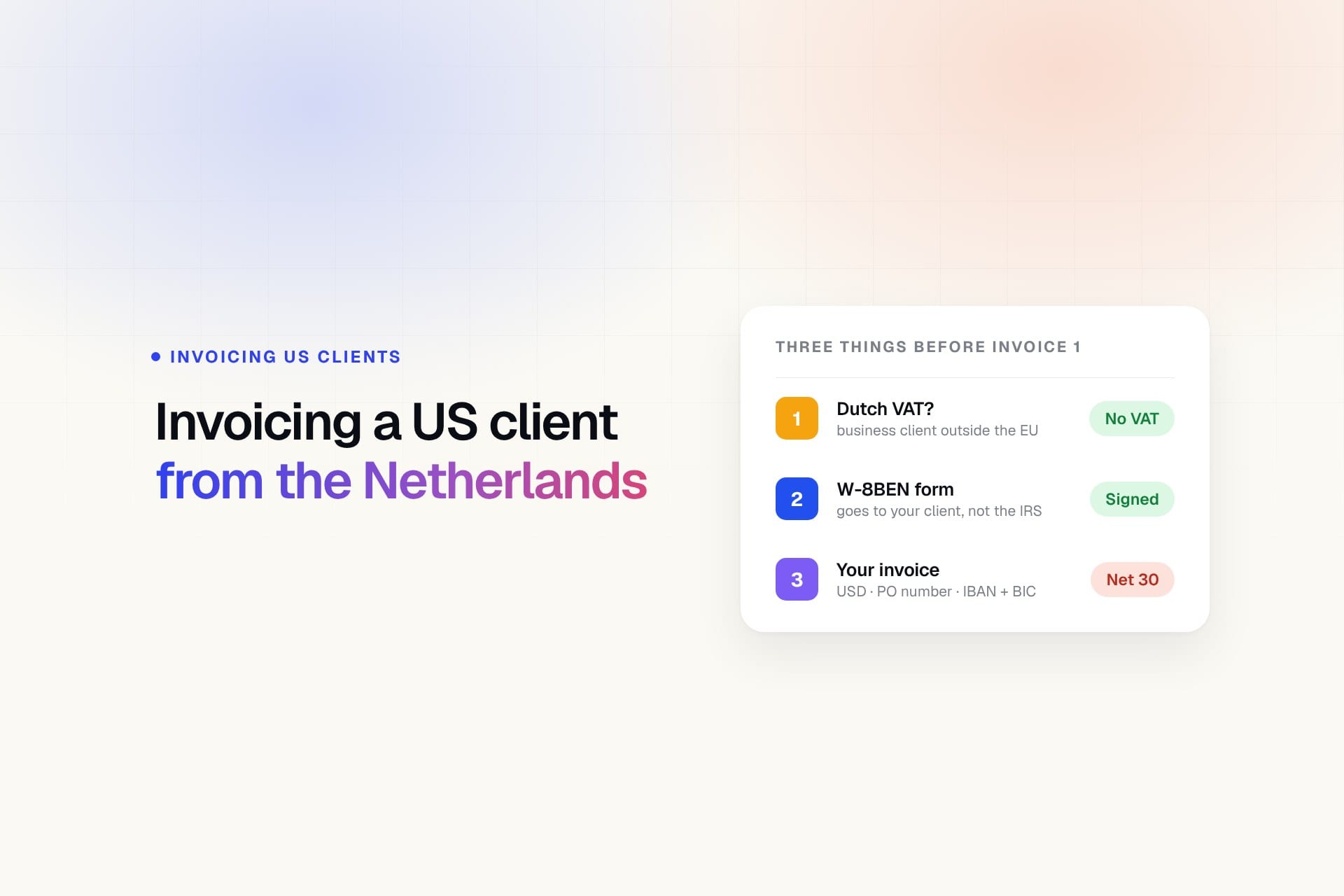
Working for a US Client from the Netherlands
A US client can be some of the best work a freelancer in the Netherlands gets. Budgets are often bigger, rates are often quoted in dollars, and remote work is entirely normal.
It also comes with questions nobody prepares you for: a form called a W-8BEN arriving by email, a payment portal that wants a "tax ID", and an invoice sitting unpaid for six weeks because it went to the wrong address.
Here's the whole picture, in the order you'll hit it.
VAT: the easy part
Start with the good news. For most freelance services supplied to a business established outside the EU, you don't charge Dutch VAT.
Your invoice to a US company shows your rate, your total, and no VAT line. There's no ICP declaration either: that's an EU-only mechanism, and the US isn't part of it.
One wording note. Don't write "VAT reverse charged" on a US invoice. Reverse charge is an EU concept. To an American bookkeeper it means nothing, and it can trigger a confused email. If you want to explain the absence of VAT, a plain line saying the service is outside the scope of Dutch VAT is clearer.
You still declare the income for income tax in the Netherlands. A foreign client doesn't change your own tax position at home.
The W-8BEN form
Sooner or later a US client will email you a form and ask you to complete it before they can pay. This is normal and not a red flag.
The US has withholding rules that require payers to deduct tax from certain payments to foreign recipients, unless the recipient certifies their foreign status. That certification is a W-8BEN if you operate as an individual (including a Dutch eenmanszaak), or a W-8BEN-E if you invoice through a BV or another entity.
Two things worth knowing:
Services performed outside the US are generally not US-source income. A developer working from Rotterdam for a company in Austin is performing the work in the Netherlands. In the usual case, no US withholding applies at all. The form is how your client documents why they didn't withhold. It protects them, and it gets you paid in full.
The Netherlands has a tax treaty with the US. If treaty benefits are relevant to your situation, the form is where you claim them, and you'll need your Dutch tax identification number.
The form asks for your name, address, country and foreign tax identification number. For a sole trader that's typically your BSN. If you invoice through a BV, it's the entity's number. It also asks for a US TIN, which you almost certainly don't have and generally don't need. Leaving it blank is normal here.
The W-8BEN goes to your client, never to the IRS. It stays in their records, and it expires, usually at the end of the third calendar year after you sign it. A long-running client will eventually ask for a fresh one.
One genuine caution: these forms are a common phishing lure. If a "W-8BEN" arrives unexpectedly from someone you have no relationship with and asks for bank details or a passport scan, it's a scam. A legitimate request comes from a client you already work with, and it never asks for your banking password or a photo of your ID.
If your situation is anything other than straightforward (you spend time working physically in the US, you license intellectual property, you earn royalties), get advice. Those are exactly the cases where withholding can genuinely apply.
Getting paid, and what it costs
This is where the money actually leaks.
A plain international wire. A domestic US transfer doesn't cross borders, so a US client paying a Dutch bank account needs an international wire. The sender typically pays a fee of around $25 to $45, an intermediary bank may take its own cut along the way, and it takes two to five days. Your own bank may charge a receiving fee on top.
Wise, Revolut Business or similar. You can hold and receive dollars as dollars, and convert when you choose. With a provider that issues you US account details, your client can often pay you as an ordinary domestic US transfer, which removes most of the wire fees. Availability depends on the provider and on whether you hold a personal or business account, so check before you put the details on an invoice. The exchange rate is close to the real mid-market rate, which is the point: for regular US work this is usually the cheapest route by a clear margin.
PayPal. Fast and familiar to American clients, but the transaction fee plus the currency conversion margin makes it expensive. Fine for a one-off, bad as a habit.
The exchange margin is the real cost. A traditional bank offering "free" currency conversion typically builds a spread of a couple of percent between the real rate and the one it gives you. On a $5,000 invoice, 2 to 3 percent is roughly €90 to €140, invisibly, every time. That is more than most wire fees, and almost nobody notices it.
Agree who pays the wire costs before the first invoice. One line in your quote. Otherwise you invoice $5,000, receive $4,955, and are left deciding whether $45 is worth an awkward email.
Invoice details that get US invoices paid
American accounts payable departments are process-driven. Small omissions cause disproportionate delays.
- Invoice in USD if that's what was agreed, with the currency stated explicitly next to every amount.
- Full international bank details: IBAN, BIC/SWIFT, your bank's name and address, and your own address. US wire forms ask for all of it, and an incomplete set means the payment doesn't leave.
- The PO number, if they issued one. At mid-size and larger US companies, an invoice without the purchase order number often doesn't get processed at all. It just sits.
- Net 30 as the expected default. Net 15 is unusual; Net 45 or Net 60 is common with larger companies. Ask before you assume.
- Send it to the right place. Many US clients have an invoicing email address or a portal (Bill.com, Coupa, SAP Ariba) separate from your day-to-day contact. An invoice emailed to your project manager may never enter the system. Ask on day one where invoices go.
- Write the date unambiguously. 09/03/2026 means 9 March in the Netherlands and 3 September in the US. Write "3 September 2026" and the ambiguity disappears.
Contract points worth ten minutes
Currency and rate. State the currency in the agreement, not just on the invoice. "USD 80 per hour" or "EUR 75 per hour, invoiced in EUR" are both fine, but ambiguity here has cost people ten percent.
Payment term and late payment. US contracts often specify a term. If yours doesn't, propose Net 30 in writing.
Governing law. US contracts frequently name a specific state. For small engagements this is usually not worth fighting over: realistically, neither of you is litigating across the Atlantic over a €5,000 invoice. For a large or long-running engagement, it's worth a conversation.
Intellectual property. US client contracts often transfer all rights on payment, sometimes broadly. Read that clause. It's the one that matters most for a freelancer.
Time zones. Not a legal point, but the practical one that decides whether the work is pleasant. A client on the US West Coast starts their day at around 17:00 your time. Agree overlap expectations before you start, not in month three.
A worked example
You're a developer in Amsterdam. A San Francisco startup hires you for a three-month project at USD 85 per hour.
- Contract: USD, Net 30, they pay wire costs, three hours of overlap on Tuesdays and Thursdays.
- Before the first invoice: you complete a W-8BEN and email it back. They confirm invoices go to their accounts payable address, with PO number 4471 on every one.
- Invoice 1, 1 October: 150 hours, USD 12,750. No VAT line. PO 4471. IBAN, BIC and bank address. You book the revenue at that day's rate, say €11,730.
- Paid 29 October into your Wise USD balance. You convert when the rate suits you. The difference against your booked €11,730 is an exchange rate difference, recorded as its own item. For how that works, see Invoicing in USD, GBP or Another Currency.
- Your VAT return: the amount goes in the box for supplies that aren't taxed in the Netherlands (rubriek 1e). No ICP declaration.
No withholding, no Dutch VAT, no drama. Almost all the complexity is in the first week, and none of it repeats.
Keeping it simple as it scales
One US client is manageable in a spreadsheet. Four US clients, two German ones and a handful of Dutch invoices is where it stops being manageable: different VAT treatments, different currencies, and a booked euro amount that doesn't match what eventually lands in the bank.
That's the situation Declair is built for. You store each client's country and VAT treatment once, so it can't be got wrong on the next invoice. You invoice in USD, with the euro equivalent calculated at a rate that is locked when you send. Invoice numbers run in one sequence whatever the currency.
General guidance for freelancers registered in the Netherlands, not tax or legal advice. US tax rules for foreign persons are genuinely complex, and situations involving physical presence in the US, royalties or licensing can differ substantially. Ask an accountant with cross-border experience if any of that applies to you.
Written by Dennis Kortekaas, developer and founder of Declair.
Related reading
Ready to get started?
Start today with Declair and save hours on your administration.