Invoicing in USD, GBP or Another Currency as a Dutch Freelancer (2026)
Your client wants to pay in dollars. Can you invoice in a foreign currency from the Netherlands, which exchange rate do you use, and what does the Belastingdienst want to see? A practical guide covering the euro VAT rule, exchange rate differences, and bank costs, with worked examples.
Invoicing in USD, GBP or Another Currency as a Dutch Freelancer
A client in New York agrees to your rate and asks for the invoice in dollars. A London agency quotes you in pounds. A Swiss company pays in francs, always has, and isn't going to change for you.
Can you invoice in a currency other than the euro while registered in the Netherlands? Yes. There's one condition that catches people out, and a few practical decisions that quietly cost money if you get them wrong.
The short answer
You can issue invoices in any currency. But if Dutch VAT applies to the invoice, the VAT amount must also be shown in euros.
That's the rule in one sentence. Everything else in this article is consequences of it.
The reason is simple: the Belastingdienst collects and refunds in euros. Your VAT return is in euros. So the VAT figure has to be translatable to a euro amount that both you and the tax office agree on.
Note what the rule does not say. The rest of the invoice — your rates, line items, subtotal, total — can stay entirely in dollars or pounds. Only the VAT amount needs a euro equivalent alongside it.
When this matters, and when it doesn't
Here's the part that surprises people: for a lot of foreign-currency invoicing, the VAT question never comes up.
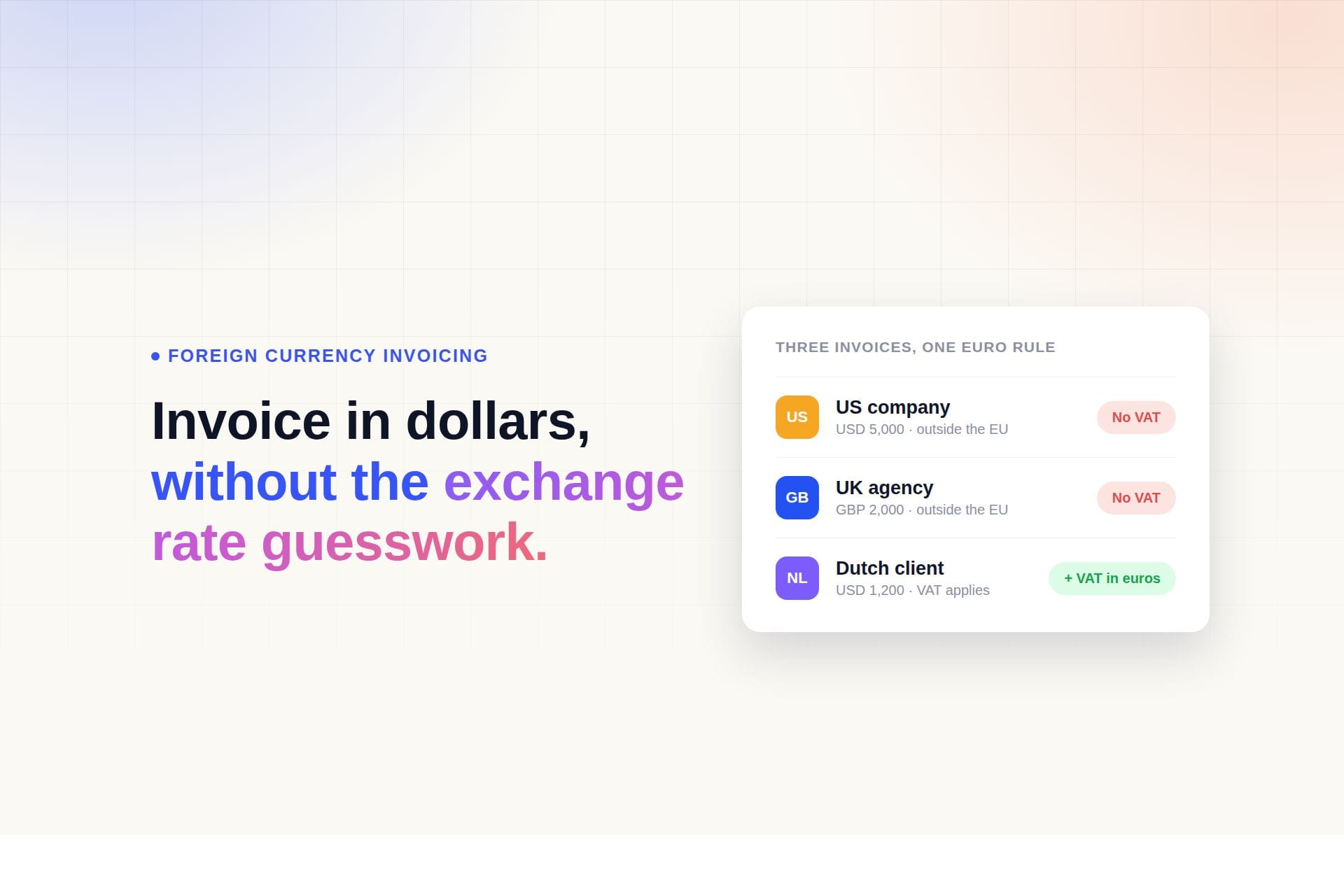
If you're invoicing a business outside the EU — the most common reason to invoice in dollars in the first place — you generally don't charge Dutch VAT at all. No VAT means no VAT amount, which means nothing to convert. You invoice USD 5,000, you're done.
The euro requirement bites in cases like these:
- A Dutch client who, for whatever reason, wants to be invoiced in dollars
- A private individual abroad where Dutch VAT applies
- Any invoice in a foreign currency that carries a Dutch VAT amount
So before you worry about exchange rates on the invoice itself, check whether VAT applies at all. Often it doesn't, and the whole question evaporates.
Even so, the exchange rate still matters — just for a different reason, which we'll get to.
Which exchange rate do you use?
Two things drive the answer: which rate, and which date.
Which rate. In practice, the European Central Bank's daily reference rate is the standard choice. It's published every working day, it's free, it's independent, and nobody will argue with it. Some businesses use the monthly rate published for customs purposes instead. Either can be defensible — what matters far more is that you pick one and never switch to whichever is more flattering. Inconsistency is what gets questioned; the specific source almost never is.
Which date. Use the rate that applies at the moment the VAT becomes due, which for most freelancers is the invoice date. Not the date the client eventually pays, which may be six weeks later at a different rate.
And then: record it. Note the rate you used and where it came from, on the invoice or in your records. Three years later during a check, "I think I used the ECB rate" is a much worse answer than a number sitting next to the invoice.
The exchange rate difference nobody warns you about
Here's what actually costs freelancers money, and it has nothing to do with VAT.
You invoice USD 5,000 on 1 September. At that day's rate, call it €4,600. That €4,600 is the revenue you book.
Your client pays on 15 October. The dollar has moved. The euros that land in your account come to €4,520.
You are €80 short. That €80 is an exchange rate difference, and it belongs in your bookkeeping as a separate item — not as a discount, not as a partial payment, and definitely not left as an invoice that appears eternally unpaid by €80.
Get this wrong and two things happen. Your accounts receivable slowly fills up with invoices that look partially unpaid but aren't. And you start sending payment reminders to clients who paid in full, which is an embarrassing email to have to walk back.
The same works in your favour when the currency moves the other way. Over a year with a handful of foreign clients, these differences are usually small. Over a year with mostly foreign clients, they add up to real money that your profit figure should reflect.
Bank costs: the second leak
There's a difference between the amount your client sends and the amount that arrives.
- Your own bank's receiving fee, often a fixed amount per international payment
- Their bank's transfer fee, if the payment is sent with charges shared
- The exchange margin — the gap between the real rate and the rate your bank gives you, which is where most banks make their actual money on currency
That margin is the one to watch. A bank that quotes "no fees" on currency conversion is usually taking two to three percent in the spread. On USD 5,000, that's more than a hundred euros, quietly, per invoice.
Two practical fixes. Agree in writing who pays transfer costs before the first invoice — a single line in your quote is enough. And if foreign currency is a regular part of your work, look at a multi-currency account (Wise, Revolut Business and several Dutch banks offer them) so you can receive dollars as dollars and convert when the rate suits you, rather than automatically at the moment of arrival.
Practical rules that save arguments
Put the currency everywhere. Not just "5,000" but "USD 5,000". Bank details, total, line items. An invoice that just says 5,000 to a client who deals in three currencies will eventually be paid in the wrong one.
Include the right bank details. For dollars you may need a SWIFT/BIC and sometimes an intermediary bank; for euros within Europe, IBAN and BIC. Missing details is the most common reason an international payment sits in limbo for a week.
Agree the currency before you start, not with the invoice. "My rate is €80 per hour, invoiced in euros" in the quote prevents the conversation where a client assumes dollars and you assumed euros and one of you is now nine percent worse off.
Keep your invoice numbering in one sequence. One continuous series across all currencies. Separate numbering per currency creates gaps, and gaps are exactly what an inspector asks about.
A worked example
March, three international invoices:
Invoice 1 — US company, USD 5,000. Business outside the EU, so no Dutch VAT. Invoice shows USD 5,000, no VAT line, no euro conversion needed on the invoice itself. You book revenue at the invoice-date rate: €4,600. Paid in April at a rate giving €4,555 — the €45 difference goes to exchange rate differences.
Invoice 2 — UK agency, GBP 2,000. Business outside the EU (post-Brexit), so again no Dutch VAT. Same treatment.
Invoice 3 — Dutch client who insists on dollars, USD 1,200. Dutch client, Dutch VAT applies. Invoice shows USD 1,200 plus 21% VAT of USD 252 — and next to it the euro equivalent of that VAT, with the rate and date noted. That euro figure is what goes in your VAT return.
Only the third invoice needed the euro conversion. That's typical.
Making it routine
None of this is difficult. It's just fiddly enough that doing it by hand in a spreadsheet, forty times a year, guarantees at least one mistake — a stale rate, a missing euro VAT line, a reminder sent to a client who paid in full.
Declair was built with this specific case in mind: invoice in the currency your client wants, with the euro VAT equivalent calculated and shown automatically at the correct date's rate, exchange rate differences recorded when payment comes in at a different rate, and one continuous numbering sequence across every currency. It's the reason the app exists in two languages as well — the clients who need multi-currency are usually the same people who need an English interface and Dutch VAT rules in the same tool.
General information for freelancers registered in the Netherlands, not tax advice. Rules for goods, digital products sold to consumers, and businesses with a presence abroad can differ. Check anything unusual with your accountant or the Belastingdienst.
Written by Dennis Kortekaas, developer and founder of Declair.
Related reading
- Invoicing a Client Abroad: VAT Reverse Charge Explained
- Unpaid Invoice — What Now? (Step-by-Step + Templates)
- What Must Be on an Invoice? (Freelancer Checklist)

Ready to get started?
Start today with Declair and save hours on your administration.