Invoicing a Client Abroad: VAT Reverse Charge Explained (2026)
Your client is in Berlin, London or New York. Do you charge 21% Dutch VAT, or not? A clear decision guide for freelancers registered in the Netherlands, with invoice wording and the ICP declaration explained.
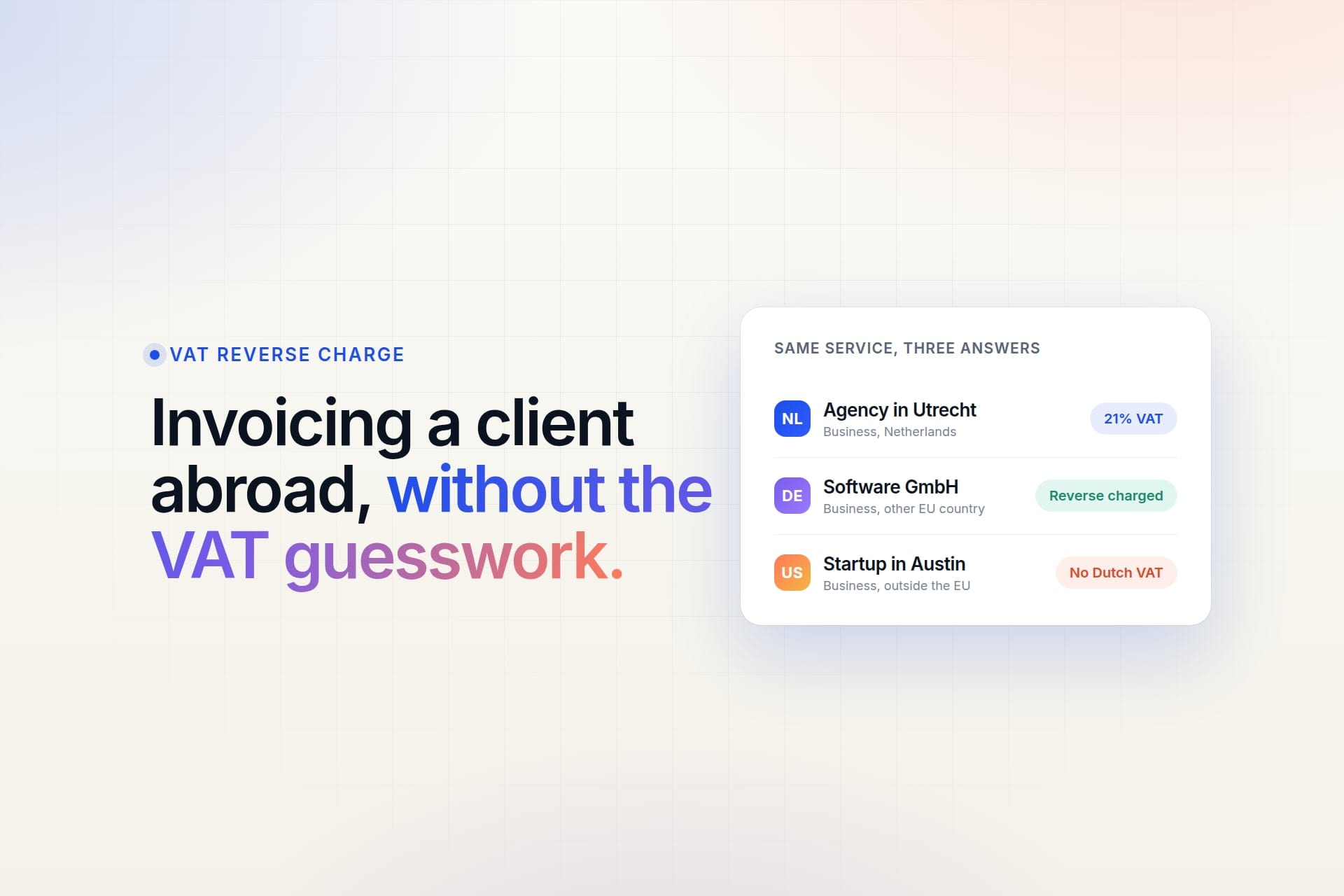
You have a new client. They're a company in Berlin, or London, or San Francisco. You've done the work, and now you're staring at your invoice template wondering whether to add 21% VAT.
Get it wrong in one direction and you've overcharged a client who will notice. Get it wrong in the other and you owe the Belastingdienst money you never collected.
The rules are more manageable than they look. Almost everything comes down to three questions, in this order.
The three questions
1. Is your client a business, or a private person?
This is the fork in the road, and it matters more than which country they're in. A German company with a VAT number is treated completely differently from a German consumer buying the same service.
2. Where is that client established?
Three groups: the Netherlands, another EU country, or outside the EU. Not "where the work happened" — where the client is based.
3. Are you supplying a service, or goods?
This guide covers services, which is what most freelancers sell: design, development, consulting, writing, translation, coaching. Goods have their own rules and their own paperwork.
The answer, in one table
For services supplied by a freelancer registered in the Netherlands:
| Client | Where | What you do |
|---|---|---|
| Business | Netherlands | Charge Dutch VAT (usually 21%) |
| Business | Other EU country | No VAT — reverse charge to the client |
| Business | Outside the EU | No Dutch VAT |
| Private person | Netherlands | Charge Dutch VAT |
| Private person | Other EU country | Usually Dutch VAT — but see the exceptions below |
| Private person | Outside the EU | Depends on the service; check before you invoice |
The row that matters most for freelancers is the second one, so let's take it apart.
Reverse charge, explained without the jargon
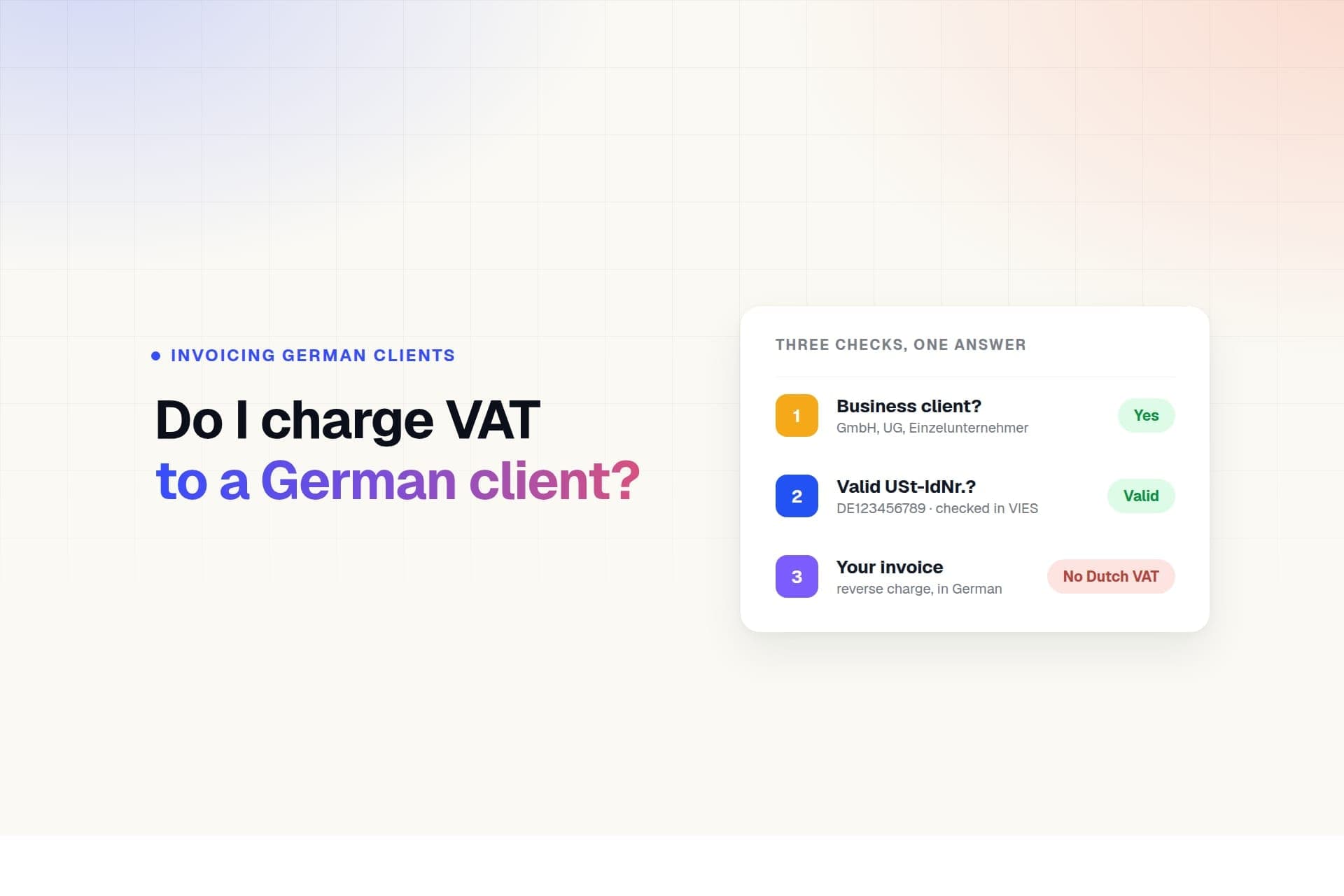
When you invoice a business in another EU country, you don't charge VAT. Instead, your client accounts for the VAT themselves in their own country, at their own rate. That's the reverse charge: the obligation moves from you to them.
This is not a loophole or a favour. It's the standard mechanism for cross-border B2B services in the EU, and your client's accountant will expect it. Sending a German company an invoice with 21% Dutch VAT on it is the kind of thing that gets an invoice bounced back.
What has to be on that invoice:
- Your own VAT identification number (the one starting with NL)
- Your client's valid VAT number, in full, on the invoice
- The words "VAT reverse charged" — or "btw verlegd", or the equivalent phrase in the client's language
- No VAT amount, and no VAT rate
That client VAT number is not decoration. It's the evidence that your client really is a business, and it's the thing you'll be asked for if anyone ever queries the invoice.
Verify the VAT number. Every time. It takes ten seconds.
The European Commission runs a free tool called VIES that checks whether a VAT number is valid and active. Search for "VIES VAT number validation" and you'll find it.
Check the number before you send the first invoice, and check it again if the relationship runs for years — companies restructure, numbers get deregistered, and an invalid number at the moment of invoicing can leave the VAT sitting with you.
Save the confirmation. A screenshot in the client folder is enough.
The ICP declaration: the step people forget
Charging no VAT is only half of your obligation. If you've supplied services to businesses in other EU countries, you also file an ICP declaration (opgaaf intracommunautaire prestaties) alongside your regular VAT return.
It's a short list: each client's VAT number, and the total you invoiced them in that period. The Belastingdienst uses it to cross-check against what your client reported on their side. When those two numbers don't match, someone gets a letter.
This is the single most commonly missed step for freelancers who land their first EU client. It's fifteen minutes of work per quarter and it is not optional.
Clients outside the EU
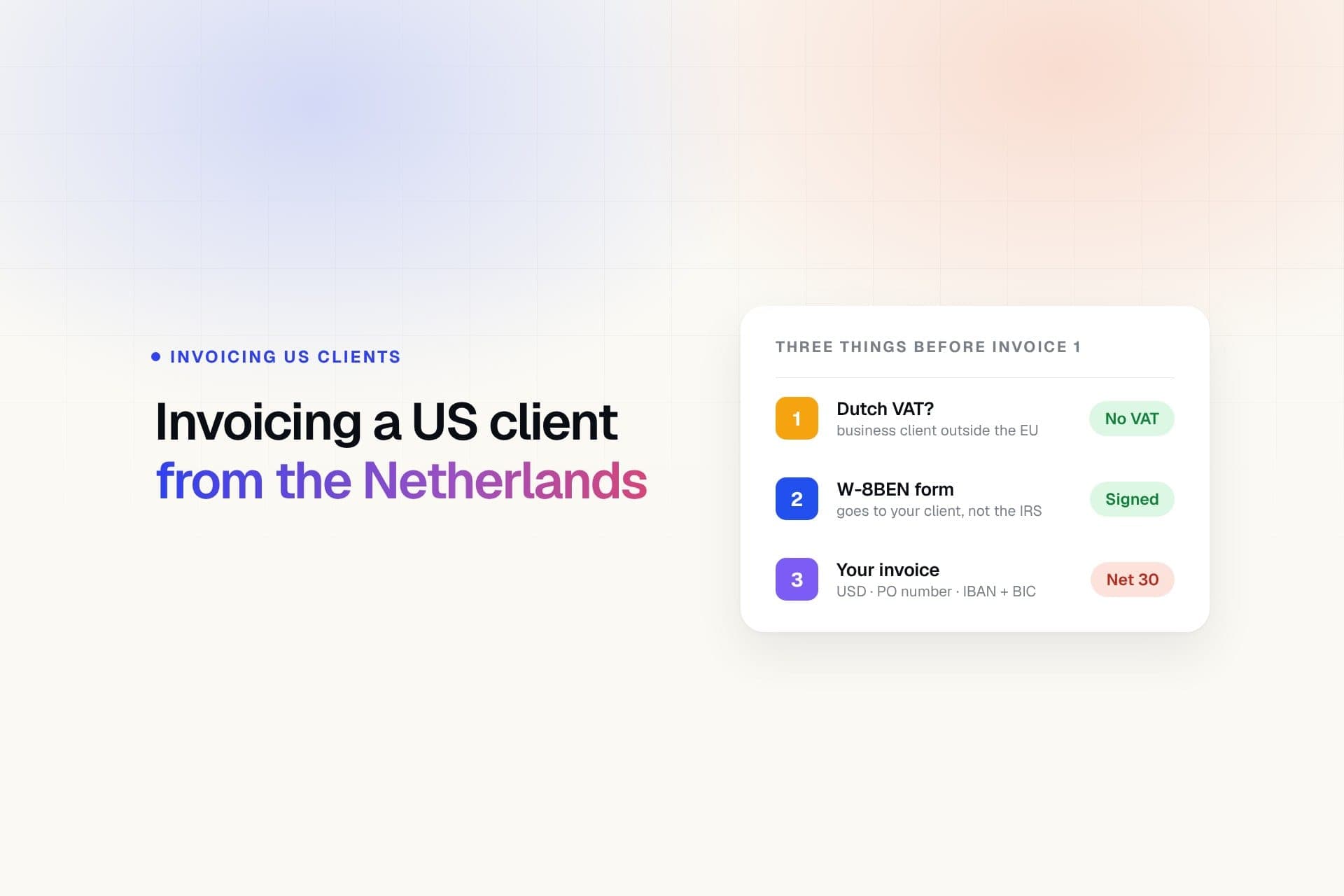
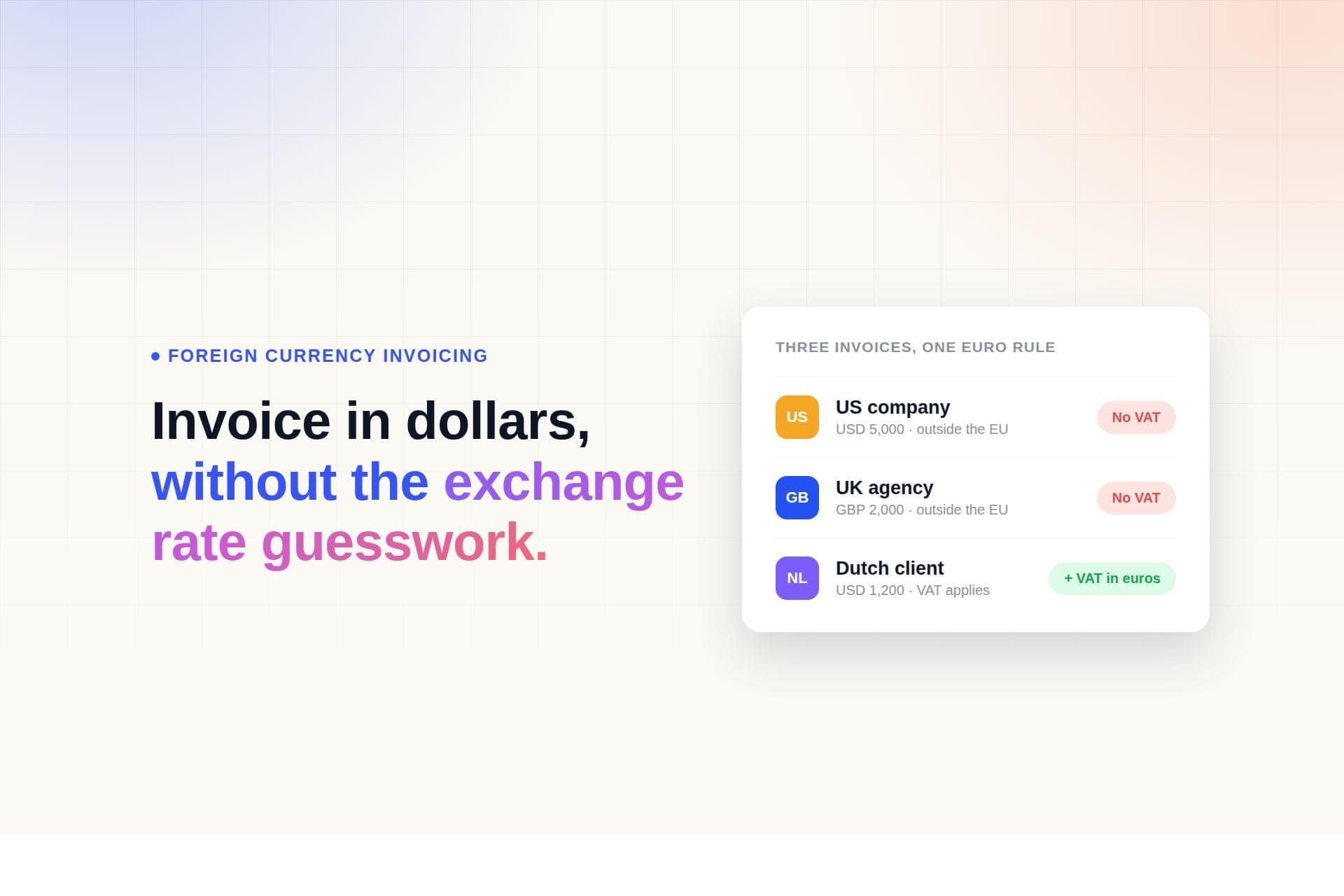
A client in the United States, the United Kingdom, Canada, Australia or Switzerland: for most freelance services, you don't charge Dutch VAT, and there's no ICP declaration either — that's an EU-only mechanism.
You still invoice normally, you still declare the income for income tax, and you still keep the paperwork. Some countries have local rules that can apply to you if you have a real presence there, but for a freelancer working from the Netherlands for a foreign company, the usual answer is: no Dutch VAT, keep good records.
A practical note on wording: don't write "VAT reverse charged" on an invoice to a US client. Reverse charge is an EU concept and it will only confuse their bookkeeper. A neutral line explaining that the service falls outside the scope of Dutch VAT is clearer.
Private clients abroad: where it gets fiddly
If your client is a private individual rather than a business, the reverse charge doesn't apply — there's no VAT-registered business to shift the obligation to. The main rule is that you charge Dutch VAT.
But there are real exceptions, and the biggest one catches a lot of freelancers: digital and electronically supplied services to consumers in other EU countries follow the customer's country, not yours. Online courses, downloadable templates, subscription software, e-books. Above a modest EU-wide threshold, that pulls you into the One Stop Shop (OSS) system, where you report other countries' VAT through a single Dutch return.
If you sell anything downloadable or subscription-based to consumers abroad, this is worth half an hour with an accountant before it becomes a problem rather than after.
Two things that trip people up
The KOR does not travel. If you're in the small business scheme (kleineondernemersregeling), you don't charge Dutch VAT domestically — but cross-border B2B services still carry their own obligations, and the KOR doesn't switch them off. If you're on the KOR and you land your first EU business client, check your position before you invoice.
Where the work happened is usually irrelevant. You can build a website sitting in Utrecht for a company in Milan, or write copy from a hotel in Lisbon for a client in Rotterdam. What matters is where your client is established, not where your laptop was.
A worked example
You're registered in the Netherlands. In September you invoice:
- A Dutch agency, €2,000 → add 21% VAT. Total €2,420.
- A German software company with a valid VAT number, €3,000 → no VAT, "VAT reverse charged" plus their VAT number on the invoice. Report €3,000 on your ICP declaration.
- A US startup, €1,500 → no Dutch VAT, no ICP.
- A private individual in Spain who hired you for one-off coaching, €400 → Dutch VAT applies. Total €484.
Four invoices, three different treatments. This is exactly why a template with "21% VAT" hard-coded into it eventually causes a problem.
Getting it right without thinking about it
The reliable fix is to make the treatment a property of the client rather than a decision you make each time you invoice. Store the country and VAT number once, set the rule once, and let every future invoice for that client inherit it.
That's how Declair handles it: you record the client's country and VAT number when you create them, and invoices pick up the correct treatment and the required wording automatically — including the reverse charge line and your ICP totals per period. The point isn't that it's clever; it's that you stop making the same decision forty times a year, which is where the mistakes come from.
This article explains the general rules for freelancers registered in the Netherlands and is not tax advice. Situations involving goods, digital products, permanent establishments abroad, or the KOR can differ meaningfully. For anything unusual, check with the Belastingdienst or your accountant — the fifteen minutes are cheaper than the correction.
Written by Dennis Kortekaas, developer and founder of Declair. He built Declair after a decade of running his own administration and getting these rules wrong at least once.
Related reading
- Dutch VAT for Freelancers: Complete Guide (BTW Explained)
- KvK Registration for Foreign Freelancers in the Netherlands
- Invoicing in USD, GBP or Another Currency as a Dutch Freelancer
Ready to get started?
Start today with Declair and save hours on your administration.