Dutch VAT for Freelancers: Complete Guide (BTW Explained) — 2026
Everything foreign freelancers need to know about Dutch VAT (BTW): rates, registration, quarterly returns, input vs output VAT, reverse charge, and the KOR exemption.
Dutch VAT for Freelancers: Complete Guide (BTW Explained) — 2026
If you are a freelancer in the Netherlands, understanding BTW (the Dutch term for VAT) is essential. Every quarter, you file a VAT return. Get it wrong, and you face fines. Get it right, and it becomes a routine part of your administration.
This guide explains everything foreign freelancers need to know about Dutch VAT: what it is, how to register, which rate to charge, how to file quarterly returns, and when special rules apply for EU clients.
By the end of this article, you will understand exactly how VAT works in the Netherlands — and how to stay compliant without needing to be a tax expert.
What is BTW?
BTW stands for Belasting over de Toegevoegde Waarde — literally "tax on added value". In English, this is called VAT (Value Added Tax).
BTW and VAT are the same thing. In the Netherlands, you will see BTW on invoices, tax forms, and in all official documents. When speaking to international clients, you can use the term VAT — they will understand it refers to the same tax.
As a freelancer, you act as a tax collector for the Dutch government:
- You charge VAT on your invoices (output VAT)
- You pay VAT on your business expenses (input VAT)
- Every quarter, you report the difference to the Belastingdienst (Dutch Tax Authority)
If you collected more VAT than you paid, you transfer the difference to the government. If you paid more VAT than you collected, the government refunds you.
Do You Need to Charge VAT as a Freelancer?
Most freelancers must charge VAT. Once you register your business with the KvK (Chamber of Commerce), you are automatically enrolled in the VAT system and receive a BTW identification number within two weeks.
There is only one exception: the KOR (Kleineondernemersregeling) — the Small Business Scheme.
The KOR — Small Business VAT Exemption
If your annual turnover is below €20,000, you can apply for the KOR. Under this scheme:
- You do not charge VAT to your clients
- You do not file quarterly VAT returns
- You cannot reclaim VAT on your business expenses
Whether the KOR is beneficial depends on your costs. If you have high business expenses (equipment, software, coworking space), reclaiming input VAT may save you more money than the administrative simplicity of the KOR.
You can opt out of the KOR at any time. Once your turnover exceeds €20,000 in a calendar year, you must opt out and start charging VAT.
Dutch VAT Rates — Which One Do You Charge?
The Netherlands has three VAT rates:
| Rate | Applies to |
|---|---|
| 21% | Most services and goods — IT, design, consulting, marketing, writing, photography, coaching, legal services, software development |
| 9% | Specific goods and services — food, non-alcoholic drinks, books, newspapers, medicine, hairdressing, bicycle and shoe repairs, hotel accommodation |
| 0% | Exports outside the EU, and services to VAT-registered businesses in other EU countries (reverse charge mechanism) |
Most freelancers charge 21% VAT on their services.
The 9% rate is limited to specific categories. If you are unsure whether your service qualifies, check the Belastingdienst's official list at belastingdienst.nl (also available in English at business.gov.nl).
How VAT Works — Output VAT vs Input VAT
Understanding the difference between output VAT and input VAT is critical.
Output VAT — VAT You Charge Clients
This is the VAT you add to your invoices. If you invoice €1,000 for a design project, you charge 21% VAT on top:
| Description | Amount |
|---|---|
| Design services | €1,000.00 |
| VAT 21% | €210.00 |
| Total | €1,210.00 |
The €210 is output VAT — you collect it on behalf of the Dutch government.
Input VAT — VAT You Pay on Expenses
This is the VAT you pay when buying goods or services for your business. If you buy a laptop for €1,210 (including 21% VAT), you paid €210 in input VAT.
You can reclaim this €210 from the Belastingdienst.
The Quarterly VAT Balance
Every quarter, you calculate:
VAT balance = Output VAT - Input VAT
Example:
- You charged €5,000 in output VAT to clients
- You paid €1,200 in input VAT on business expenses
- Balance: €3,800 — you owe this to the Belastingdienst
If your input VAT is higher than your output VAT (for example, you bought expensive equipment), the balance is negative and the Belastingdienst refunds you.
Quarterly VAT Returns — Deadlines and Process
As a Dutch freelancer, you file four VAT returns per year — one for each quarter.
| Quarter | Period | Filing deadline |
|---|---|---|
| Q1 | January – March | 30 April |
| Q2 | April – June | 31 July |
| Q3 | July – September | 31 October |
| Q4 | October – December | 31 January (following year) |
How to File
You file your VAT return through Mijn Belastingdienst Zakelijk — the online portal for business taxes.
What you report:
- Total output VAT — VAT you charged clients
- Total input VAT — VAT you paid on expenses
- Any special transactions — reverse charge, exports, private use of business goods
The system calculates your balance automatically. If you owe money, you must pay before the deadline. If you are owed a refund, the Belastingdienst transfers it to your bank account within 2-4 weeks.
Late Filing = Automatic Fines
The Belastingdienst does not send reminders. Missing a deadline results in an automatic fine — typically €60-€150 for the first offense, increasing for repeated violations.
Set calendar reminders for:
- 20 April (Q1 deadline approaching)
- 21 July (Q2 deadline approaching)
- 20 October (Q3 deadline approaching)
- 20 January (Q4 deadline approaching)
What Qualifies as Input VAT?
You can reclaim VAT on any expense made wholly and exclusively for your business.
You CAN reclaim VAT on:
- Laptops, monitors, phones, office furniture
- Software subscriptions (Adobe, Microsoft, Slack, etc.)
- Coworking space or office rent
- Professional development (courses, books, conferences)
- Business travel (train tickets, flights, hotels)
- Accountant and legal fees
- Marketing and website costs
You CANNOT reclaim VAT on:
- Personal groceries or clothing
- Commuting costs (home to office)
- Entertaining clients (meals, drinks, tickets) — 0% deductible in the Netherlands
- Expenses without a valid VAT invoice
Always keep the original invoice as proof. The Belastingdienst may audit your returns and will reject claims without proper documentation.
Reverse Charge for EU Business Clients
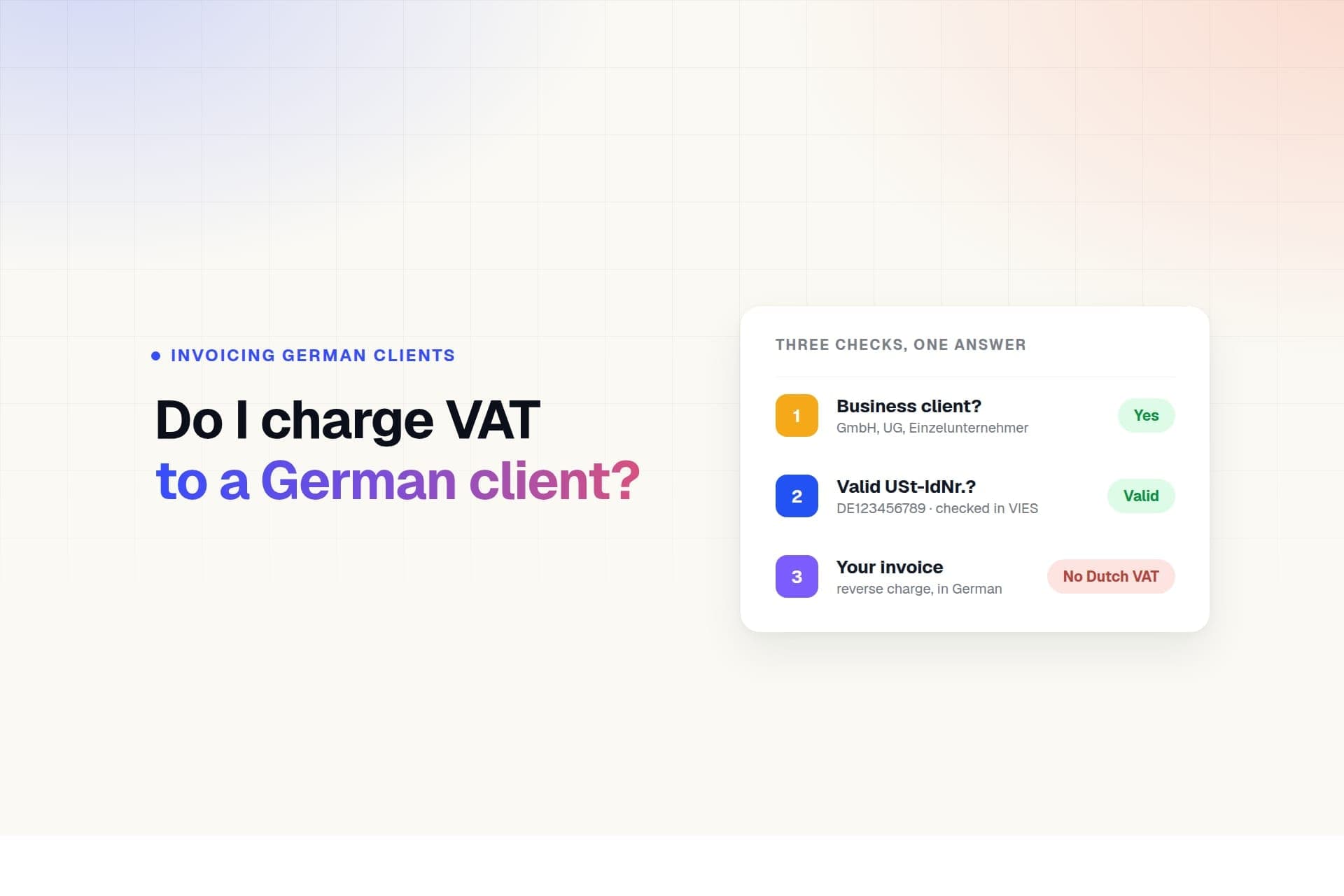
If you invoice a VAT-registered business in another EU country (Belgium, Germany, France, etc.), special rules apply.
How Reverse Charge Works
Instead of charging 21% Dutch VAT, you:
- Charge 0% VAT
- Include your client's VAT number on the invoice
- Write: "VAT reverse charged" or "BTW verlegd"
- File an ICP declaration each quarter
Your client then accounts for the VAT in their own country under their local rules.
Example invoice to a German business:
To: Beispiel GmbH
VAT number: DE123456789

Services: Web development — 40 hours @ €100/hour
Subtotal (excl. VAT): €4,000.00
VAT 0% (reverse charge): €0.00
Total: €4,000.00

VAT reverse charged — client accounts for VAT under German law.
The ICP Declaration
The ICP (Opgaaf Intracommunautaire Prestaties) is a quarterly declaration listing all reverse charge transactions. You file it through Mijn Belastingdienst Zakelijk alongside your VAT return.
You report:
- Client's VAT number
- Country code
- Total invoiced amount (excluding VAT)
What if Your Client is a Private Individual in the EU?
Reverse charge only applies to VAT-registered businesses. If your client is a private individual in Belgium or Germany, you charge 21% Dutch VAT as normal.
VAT on Digital Services to Private Individuals Outside the Netherlands
If you sell digital services (e-books, online courses, software subscriptions) to private individuals in other EU countries, different rules apply.
You must charge the VAT rate of your customer's country, not the Dutch rate. This is called the OSS scheme (One Stop Shop, formerly known as MOSS).
Most freelancers do not trigger this rule, as it only applies when you sell directly to consumers across borders. If you work B2B (business to business), reverse charge applies instead.
Common VAT Mistakes Expat Freelancers Make
Mistake 1 — Forgetting to Charge VAT
Some freelancers assume VAT is optional or forget to add it to their invoices. This is a serious error. If you are registered for VAT, every invoice must include VAT (except in reverse charge scenarios).
Mistake 2 — Using the Wrong BTW Number
You have two BTW numbers:
- BTW identification number (NL…B01) — use this on all invoices
- BTW tax number — use this only when filing returns with the Belastingdienst
Putting the tax number on invoices is a common mistake.
Mistake 3 — Not Keeping Receipts
You cannot reclaim input VAT without the original invoice. Keep digital or physical copies of every business expense. A bank statement alone is not sufficient proof.
Mistake 4 — Missing the ICP Declaration
If you invoice EU businesses using reverse charge but forget to file the ICP declaration, the Belastingdienst will fine you. The ICP is mandatory whenever reverse charge applies.
Mistake 5 — Claiming VAT on Non-Deductible Expenses
Entertainment expenses (client dinners, concert tickets) are 0% deductible in the Netherlands. You cannot reclaim the VAT, even if the expense was for a client.
Do You Need an Accountant?
You do not legally need an accountant to file VAT returns. The Mijn Belastingdienst portal is accessible in Dutch only, but the process is straightforward once you understand it.
Many expat freelancers hire an accountant for the first year, then file independently once they are familiar with the system. A Dutch accountant typically charges €300-€600 per year for quarterly VAT filings.
Alternatively, use invoicing software with built-in VAT tracking. Declair automatically categorizes your output VAT and input VAT, then generates a quarterly overview. You can download the report and use it to file your return in minutes.
Summary — VAT Checklist for Freelancers
REGISTRATION
☐ Registered with the KvK
☐ Received BTW identification number from Belastingdienst
☐ Decided whether to apply for KOR (if turnover < €20,000)

INVOICING
☐ Charge correct VAT rate (21%, 9%, or 0%)
☐ Use BTW identification number on all invoices
☐ Apply reverse charge for EU business clients
☐ Include client VAT number when using reverse charge

QUARTERLY RETURNS
☐ Track output VAT (VAT charged to clients)
☐ Track input VAT (VAT paid on expenses)
☐ File VAT return before quarterly deadlines
☐ File ICP declaration if you have EU business clients
☐ Pay VAT balance or receive refund

RECORD KEEPING
☐ Keep all invoices (sent and received) for 7 years
☐ Store receipts and proof of expenses
☐ Back up financial records digitally
Frequently Asked Questions
What is BTW and how does it differ from VAT?
BTW (Belasting over de Toegevoegde Waarde) is simply the Dutch term for VAT (Value Added Tax). They are the same thing. In the Netherlands, you will see BTW used on invoices, tax forms, and in all communication with the Belastingdienst. When speaking to international clients, you can use VAT — they will understand it means the same as BTW.
Do all freelancers in the Netherlands need to charge VAT?
Most freelancers must charge VAT. The exception is if you qualify for the KOR (Kleineondernemersregeling) — the Small Business Scheme. If your annual turnover is below €20,000, you can apply to be VAT-exempt. This means you do not charge VAT and do not file quarterly returns, but you also cannot reclaim VAT on your expenses.
What is the difference between output VAT and input VAT?
Output VAT is the VAT you charge your clients on your invoices. Input VAT is the VAT you pay on your business expenses (software subscriptions, equipment, office supplies). Every quarter, you report both to the Belastingdienst. If your input VAT is higher than your output VAT, you receive a refund. If your output VAT is higher, you pay the difference.
How often do I need to file a VAT return in the Netherlands?
As a freelancer, you file VAT returns quarterly — four times per year. The deadlines are 30 April (Q1), 31 July (Q2), 31 October (Q3), and 31 January (Q4). You file through the Mijn Belastingdienst Zakelijk portal. Missing a deadline results in automatic fines.
What is reverse charge and when does it apply?
Reverse charge means your client accounts for the VAT instead of you. It applies when you invoice a VAT-registered business in another EU country. You charge 0% VAT, include your client's VAT number on the invoice, and write "VAT reverse charged". You must also file an ICP declaration each quarter listing these transactions.
Can I reclaim VAT on expenses I had before registering my business?
Yes, but only for expenses made in the year before your official KvK registration date, and only if you still have the original invoices. This is called startup deduction (startersaftrek). Keep all receipts and invoices — you can reclaim the input VAT on your first quarterly return.
What happens if I miss the quarterly VAT filing deadline?
The Belastingdienst issues automatic fines for late VAT returns. The first offense typically results in a fine of €60-€150. Repeated late filings result in higher fines and potential audits. If you know you will miss a deadline, contact the Belastingdienst in advance — they may grant an extension.
Do I need a Dutch accountant to file my VAT returns?
No, you can file your own VAT returns through Mijn Belastingdienst Zakelijk. However, many expat freelancers use an accountant for the first year to ensure they understand the system correctly. A good invoicing tool like Declair automatically generates quarterly VAT overviews, making it much easier to file accurately.
New to freelancing in the Netherlands? Also read our guide on how to invoice as a freelancer in the Netherlands or learn about KvK registration for foreign freelancers.
Ready to get started?
Start today with Declair and save hours on your administration.