Do I Charge VAT to a Client in Germany? A Decision Tree (2026)
Germany is the most common first foreign client, and where most people make their first cross-border VAT mistake. A step-by-step decision tree: when Dutch VAT applies, how to check a Umsatzsteuer-ID in VIES, the wording German bookkeepers expect, and the four mistakes that cost the most.
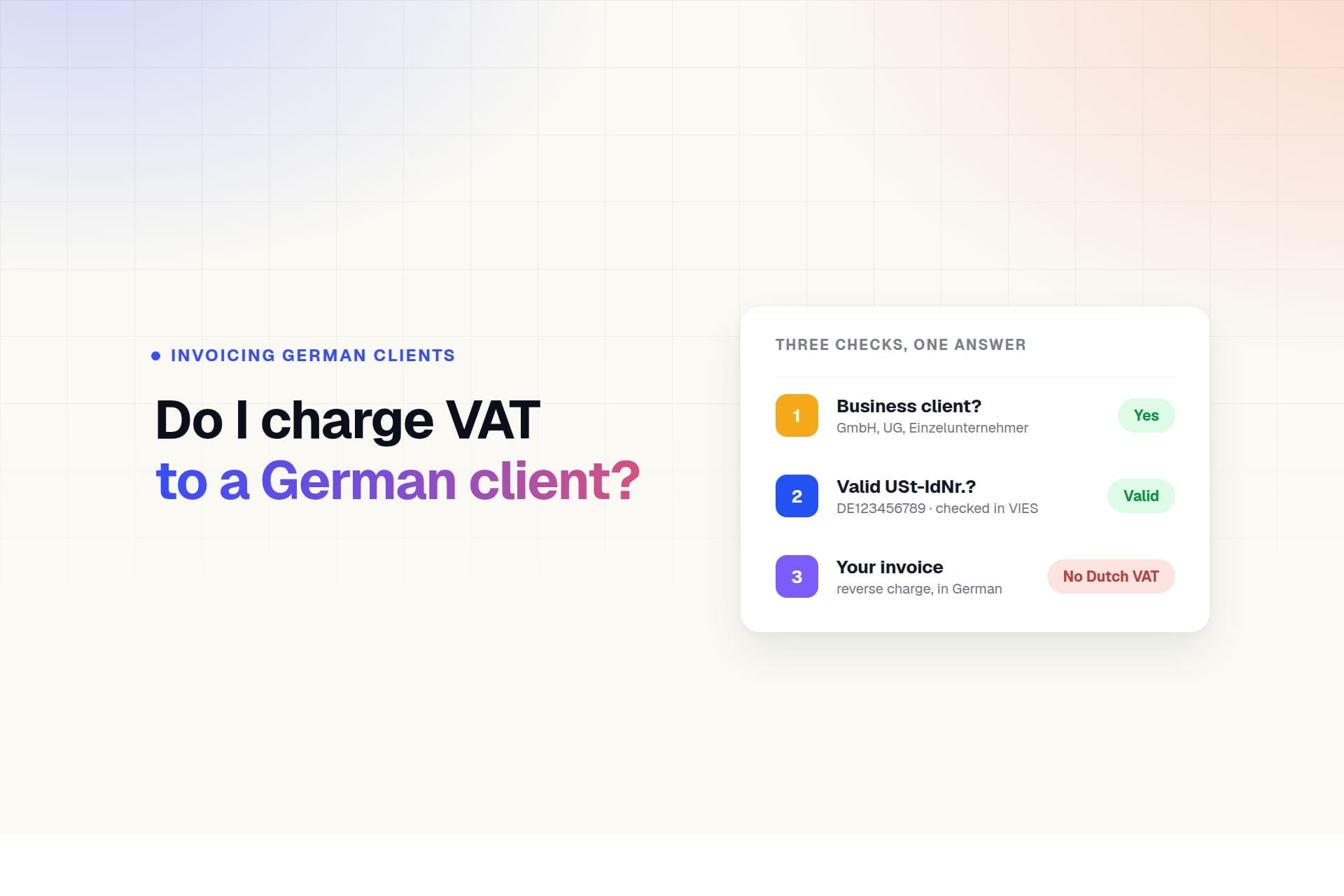
Do I Charge VAT to a Client in Germany? A Decision Tree
Germany is the most common first foreign client for freelancers based in the Netherlands. It's next door, the market is enormous, and German companies are used to working with Dutch suppliers.
It's also where most people make their first cross-border VAT mistake — usually one of two: charging 21% Dutch VAT when they shouldn't, or leaving the client's VAT number off the invoice and having it sent straight back.
Here's the decision tree, then the practical details that the tree doesn't cover.
The decision tree
Start: your client is in Germany. You're registered in the Netherlands. You supplied a service.
Question 1 — Is your client a business?
A company, a GmbH, a UG, a registered sole trader (Einzelunternehmer), an agency. Anyone acting in a business capacity.
- No, it's a private individual → go to Question 4.
- Yes → go to Question 2.
Question 2 — Do they have a valid German VAT identification number (Umsatzsteuer-Identifikationsnummer)?
- No, or they can't give you one → treat with caution. Go to Question 3.
- Yes, and it validates in VIES → No Dutch VAT. Reverse charge applies. Put their VAT number and "VAT reverse charged" on the invoice, and report the amount on your ICP declaration. Done.
Question 3 — They're a business but have no valid VAT ID.
Some very small German businesses fall under the Kleinunternehmerregelung, Germany's equivalent of the KOR, and don't always have an active VAT identification number. This is genuinely awkward: without a valid number you can't safely apply the reverse charge, but the client may well still be a business.
Don't guess. Ask them to request a VAT identification number from the Bundeszentralamt für Steuern — it's free, and they can do it online. Most will, once they understand you can't invoice them properly otherwise. If they refuse or can't, ask your accountant before invoicing. This is one of the few situations where a fifteen-minute question genuinely saves money.
Question 4 — Your client is a private individual in Germany.
- Is the service digital or electronically supplied? (online course, downloadable file, subscription software, e-book) → German VAT may apply via the One Stop Shop, above the EU-wide threshold. Check before you invoice.
- Is it a regular service? (consulting, design, development, writing) → the main rule is Dutch VAT. Charge 21% as you would for a Dutch client.
- Does it relate to property in Germany? (architecture, construction supervision, anything tied to a specific building or plot) → different rules apply. This is a special case; ask before invoicing.
That's the whole tree. For the large majority of freelancers the answer is the one at Question 2: business client, valid VAT number, reverse charge, no Dutch VAT.
Checking a German VAT number
A German VAT identification number looks like DE123456789 — the letters DE followed by nine digits.
Watch out for a common confusion: German businesses have two tax numbers, and clients send the wrong one all the time.
- The Steuernummer is their domestic tax number, formatted with slashes (like 12/345/67890). This is not what you need. It doesn't validate in VIES and it doesn't belong on your invoice.
- The Umsatzsteuer-Identifikationsnummer (USt-IdNr.) is the DE-number. This is the one.
If a client sends you something with slashes in it, go back and ask for the USt-IdNr. specifically, using the German word — that removes all ambiguity.
Validate it in VIES before the first invoice and keep the confirmation.
What German bookkeepers expect to see
Technically your invoice needs to meet Dutch requirements, and that's what matters legally. But an invoice that a German accounts payable department finds unfamiliar gets queried, and a queried invoice gets paid late. A few small things smooth that considerably:
- Both VAT numbers clearly labelled, yours and theirs.
- The reverse charge wording, ideally in German: Steuerschuldnerschaft des Leistungsempfängers. That's the standard phrase and it's instantly recognised. Adding the English "VAT reverse charged" alongside it does no harm.
- A clear invoice date and a clear service period. German bookkeeping is precise about which period a cost belongs to; "August 2026" as a service period saves an email.
- Your IBAN and BIC. Obvious, but international invoices lose more time to missing bank details than to anything else.
- A purchase order or reference number if they gave you one. In larger German companies, an invoice without the PO number simply doesn't get processed.
Payment terms: adjust your expectations
Dutch freelancers commonly work with 14-day terms. In Germany, 30 days is the norm and larger companies often work to their own standard terms regardless of what your invoice says.
Two practical consequences. Agree the payment term in writing before you start, not on the invoice. And don't send a reminder on day 15 — with a German client that reads as unnecessarily aggressive, and it's very often simply their standard process running its course.
If you do need to chase, be aware that within the EU there are statutory rules on late payment and a right to compensation for collection costs. But for a client relationship you want to keep, the phone call comes long before the legal argument.
The four mistakes that cost the most
1. Charging 21% Dutch VAT to a German business. The most common one. Your client can't reclaim Dutch VAT through their normal German return, so they'll ask you to reissue — and you've delayed your own payment by two weeks.
2. Forgetting the ICP declaration. No Dutch VAT charged doesn't mean no reporting. Your German client reports the purchase on their side; when the two don't match, the mismatch surfaces.
3. Accepting the Steuernummer instead of the USt-IdNr. It won't validate, and your evidence that the client is a business is worth nothing.
4. Assuming it works the same for private clients. Reverse charge only exists between businesses. An individual in Munich who hires you for a one-off job generally gets Dutch VAT.
A worked example
October, one German client:
You invoice a Hamburg design agency €4,000 for a development project. They gave you DE987654321, which validates in VIES.
Your invoice shows: €4,000, no VAT, no VAT rate, your NL VAT number, their DE number, the line Steuerschuldnerschaft des Leistungsempfängers, service period September 2026, 30-day payment term, IBAN and BIC.
In your Q4 VAT return, that €4,000 goes in the box for services supplied to other EU countries. In your ICP declaration for the same period: DE987654321, €4,000.
Two filings, one invoice. Neither takes more than a couple of minutes if you record the client's details properly the first time.
Making it automatic
The reason this feels harder than it is: you're making the same decision repeatedly, from memory, at the moment you're trying to get an invoice out the door.
Declair takes the decision out of the invoice and puts it on the client. You store the country and VAT number once — with VIES validation — and every invoice for that client is generated with the correct treatment and the required wording, in German or English as appropriate, with the ICP totals ready per period. You make the decision once, when you have the time to think about it, rather than forty times when you don't.
General guidance for freelancers registered in the Netherlands, not tax advice. Rules for goods, digital products, property-related services and small business schemes differ. Check unusual cases with the Belastingdienst or your accountant.
Written by Dennis Kortekaas, developer and founder of Declair.
Related reading
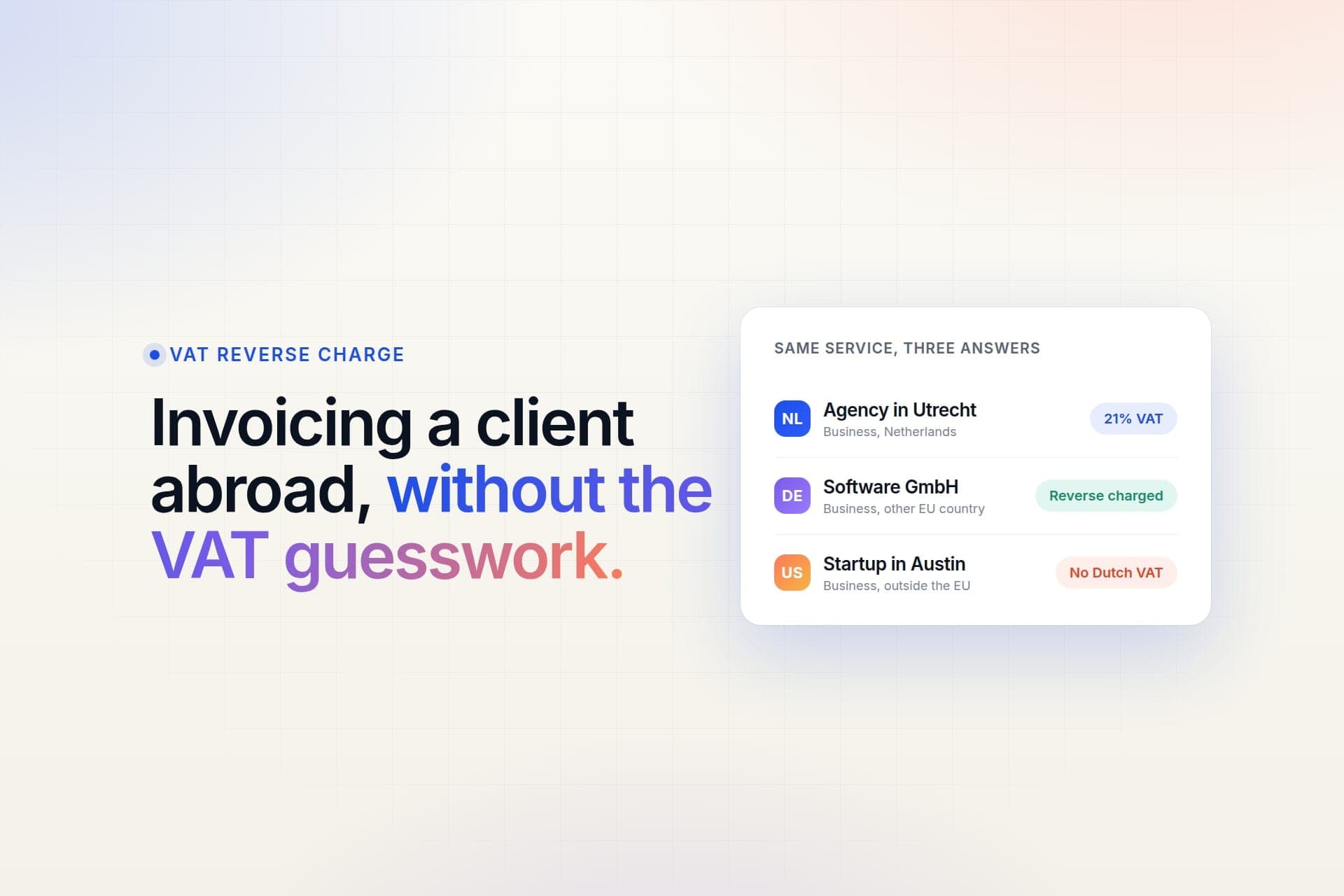
- Invoicing a Client Abroad: VAT Reverse Charge Explained
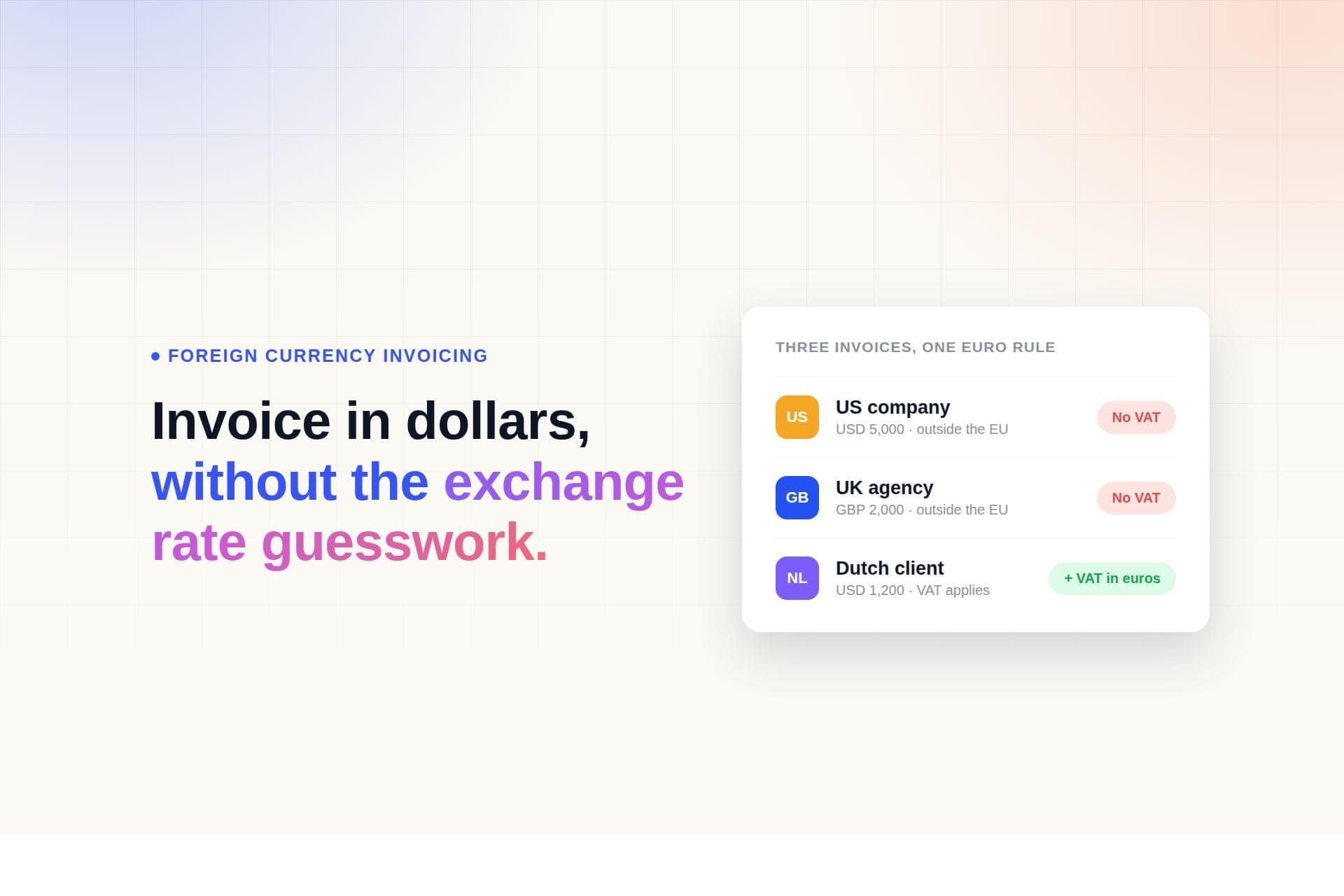
- Invoicing in USD, GBP or Another Currency as a Dutch Freelancer
- Unpaid Invoice — What Now?
Gerelateerde artikelen

Klaar om te beginnen?
Start vandaag nog met Declair en bespaar uren op je administratie.